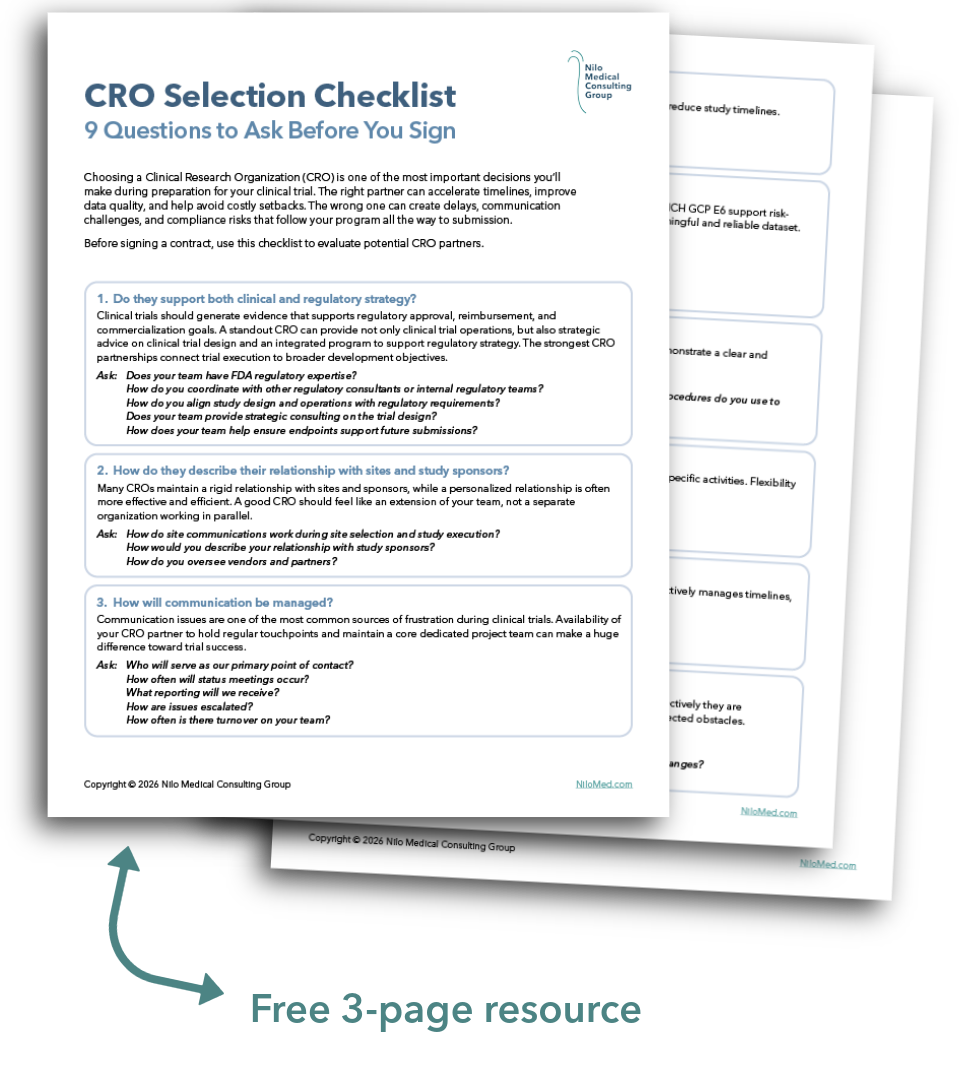
FREE CRO SELECTION RESOURCE
Choose the Right CRO
for Your Clinical Trial
9 Questions to Ask
Potential CRO Partners
Selecting a CRO is one of the most important decisions you’ll make during clinical development. The right partner can help you reduce risk, maintain study momentum, generate high-quality data, and keep clinical execution aligned with your broader development strategy.
We respect your privacy. Your information will only be used to send you this resource and relevant updates from NMCG. You can unsubscribe at any time.
Identify Gaps Before They Become Startup Delays
The strongest CRO partnerships connect trial execution with the larger goals of your clinical development program.
That means looking beyond a capabilities list. Sponsors should understand who will actually work on their study, how clinical and regulatory decisions are connected, how communication and escalation are handled, and whether the CRO has the flexibility and expertise to respond as the study evolves.
This checklist helps you ask those questions before you commit.

9 Areas to Evaluate Before Choosing a CRO

Clinical + Regulatory Alignment
Determine whether clinical strategy and trial execution align with regulatory requirements and broader development objectives.
Use the checklist to assess potential partners across the factors that can influence study execution and your experience working together.

Team Integration + Continuity
Understand who will work on your study, how involved they’ll be, and how the CRO maintains continuity across functions and throughout the trial.

Data Quality Processes
Understand how monitoring, source data verification, quality control, EDC management, and database validation ensure submission-ready data.

Performance Measurement
Assess how the CRO tracks study performance, manages timelines
and quality metrics, and proactively identifies and mitigates risks.

Communication Approach
Evaluate meeting cadence, reporting, transparency, escalation
processes, and access to the experts supporting your study.

Safety Oversight
Evaluate how the CRO manages safety processes, adverse event
reporting, and oversight committees such as DSMBs and CECs.

Problem-Solving Ability
Understand how the CRO anticipates challenges, develops contingency plans, and responds to unexpected study, enrollment, or regulatory issues.

Site Startup Capabilities
Assess how the CRO identifies, qualifies, and activates sites and
manages contracting, budgeting, and training.

Flexibility
Determine whether services can be tailored to your needs and
resources scaled appropriately as your study evolves.
Compare CROs More Objectively
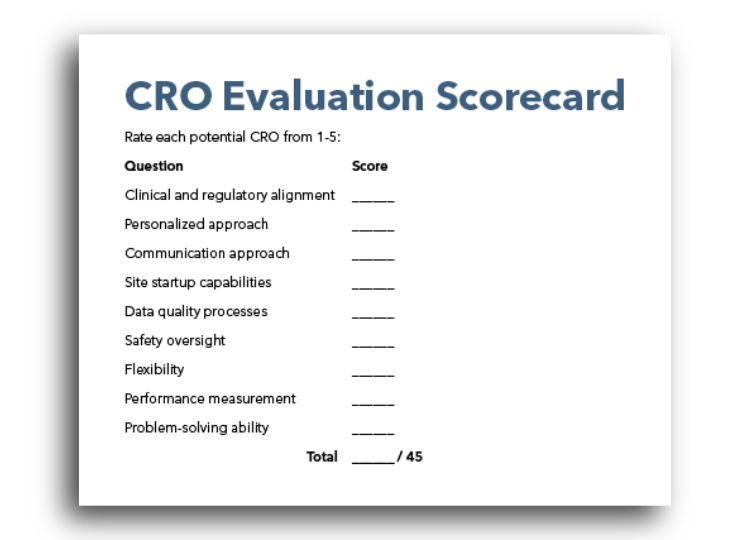
The checklist also includes a CRO Evaluation Scorecard that lets you rate each
potential partner across all nine selection criteria and calculate an overall score.
Use it during CRO interviews and proposal reviews to document what you learn
and compare potential partners using the same framework.
What Should the Right CRO Partnership Look Like?
A CRO is a critical partner in your development program. Look for a team that understands your study beyond its individual tasks and can connect decisions across clinical strategy, regulatory requirements, and trial operations.
At Nilo Medical Consulting Group, our integrated team structure gives the people supporting your study a deep understanding of your product, protocol, and development objectives. With fewer handoffs between functions,
our team can respond quickly as needs evolve and provide thoughtful, cost-effective support throughout the study.
Whether you need full-service CRO support or expertise for specific aspects of your trial, NMCG can tailor its
support to your clinical development needs.

Choosing a CRO for Your Next Clinical Trial?
Start with the questions that can help you identify the right partner before you sign.
Download the CRO Selection Checklist and use the included scorecard to evaluate your options.
Helping medical device, diagnostic, and pharmaceutical innovators accelerate safe, effective products to market.